
How AI Is Changing Digital Marketing in 2026
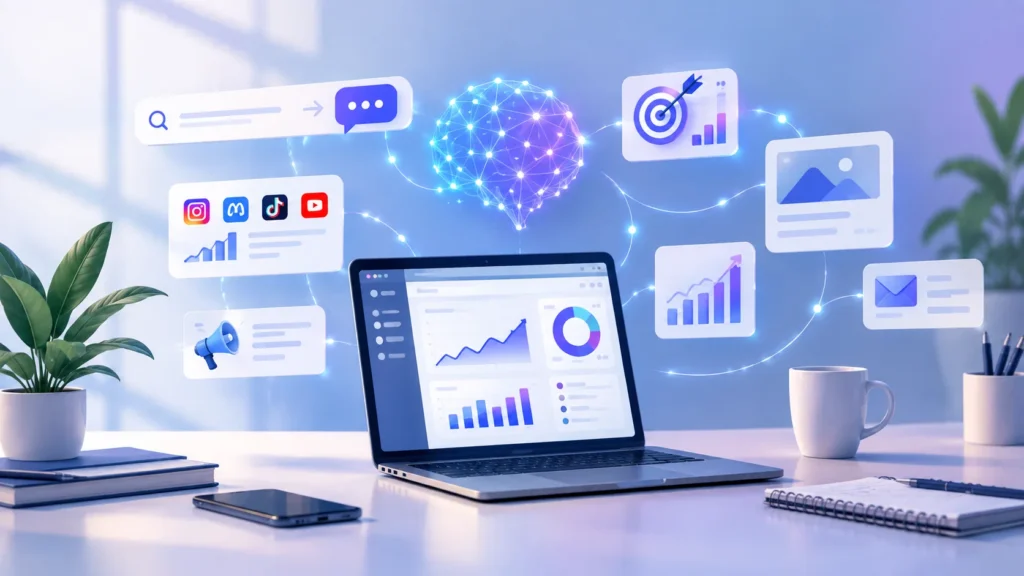
Remember when “AI in marketing” basically meant a chatbot that misunderstood your question three times before connecting you to a human? Yeah, that phase is pretty much over. Walk into any marketing team’s stand-up today and AI isn’t the shiny new tool someone’s testing on the side — it’s just… there. Running through the ad spend, drafting the first pass of the email, flagging which customers are about to churn before anyone noticed a pattern.
So what’s actually changed, beyond the hype? Here’s what I’m seeing.
Key Shifts Driving This Change
1. Search Is No Longer Just Search
Here’s the thing nobody saw coming quite this fast: people stopped typing keywords and started just… asking. Instead of googling “best running shoes flat feet,” someone now types (or says) “what running shoes should I get, I’ve got flat feet and not much of a budget” into an AI assistant — and gets back an actual answer, with picks, not ten blue links.
That’s rattled a lot of SEO playbooks. It’s not enough to rank #1 on Google anymore (though sure, that still helps). Now brands are chasing something a bit blurrier: getting cited by the AI itself. That means writing content that’s actually clear and well-sourced, tagging things properly with schema, and — honestly — just being credible enough that a model trusts you as a source. People are calling this GEO (generative engine optimization), though I suspect the name will change five more times before it sticks.
2. Hyper-Personalization at a Scale Humans Can’t Match
“Hi [First Name]” used to count as personalization. Wild to think about now. What’s happening in 2026 is a lot more granular — systems are watching how someone scrolls, where they hesitate, what time of day they’re browsing, and adjusting the message in real time, not the next campaign cycle.
A few places this shows up:
- Email and ad copy that’s rewritten per person, not per segment
- Websites that quietly reorder themselves based on what you seem to want
- A product recommendation at 11pm that reads differently than the one you’d get at lunch
The upshot? Campaigns that used to ship with five variants now effectively have unlimited ones, constantly testing themselves against each other.
3. Creative Production Has Compressed
Ad copy, image concepts, a rough video cut — stuff that used to eat up a creative team’s whole week now gets a first draft in an afternoon. AI’s doing a lot of the grunt work: drafting, generating, editing, even voiceover.
But here’s what’s interesting — this hasn’t made creative teams less important, it’s just changed what they’re actually doing. Less “produce the thing,” more “decide if the thing is any good and sounds like us.” The teams pulling ahead aren’t the ones cranking out the most content. They’re the ones running more experiments, killing the bad ideas faster, and keeping enough of a real voice that none of it feels like it came out of a machine (even when it did).
4. Predictive Analytics Moved From “Nice to Have” to Default
Not long ago, predicting who was about to churn or which leads were worth chasing meant you needed an actual data science team on staff. Now it’s just baked into most marketing platforms out of the box. You can see, before a campaign even goes live, which segments are likely to bite and which creative is probably going to flop.
Budgets have shifted because of it — less “spend and hope,” more “spend where the model says it’ll land, and adjust as you go.”
5. AI Agents Are Running Campaigns, Not Just Assisting Them
This one’s the big shift, honestly. AI isn’t just suggesting anymore — it’s doing. Autonomous agents are adjusting bids, pausing an underperforming ad, moving budget between channels, kicking off follow-up sequences, all without someone clicking “approve” first.
Marketers are spending more time setting the strategy and the guardrails, less time babysitting the day-to-day. It’s a shift from operator to supervisor — which is great for efficiency, but it does raise a real question: how much do you let it run on its own before someone should be looking over its shoulder?
6. Trust, Authenticity, and the Backlash Factor
Funny thing about a world flooded with AI content: people got more skeptical, not less. There’s a real premium now on stuff that feels unmistakably human — actual customer stories, rough behind-the-scenes footage, brands being upfront about where AI was involved.
Some are leaning into “human-made” as an actual selling point. And regulators are catching up too — more places now require disclosure when AI’s involved in ads, especially with synthetic media or influencer content.
What This Means for Marketers in 2026
- SEO folks need to stop thinking only about Google and start thinking about how AI assistants summarize and surface things
- Creative teams are shifting from “make more” to “make it good and make it ours”
- Analytics is getting more strategic — less number-crunching, more deciding how much autonomy the models get
- Trust and transparency aren’t just nice values anymore, they’re a genuine edge
POV
At the end of the day, AI hasn’t replaced marketing strategy — it’s just raised the floor on execution and made “good enough” a lot harder to get away with. The brands doing well in 2026 aren’t necessarily the ones with the fanciest AI stack. They’re the ones who figured out how to pair that speed and scale with something AI still can’t fake: an actual point of view.