SEO vs AEO vs GEO: What's the Difference?
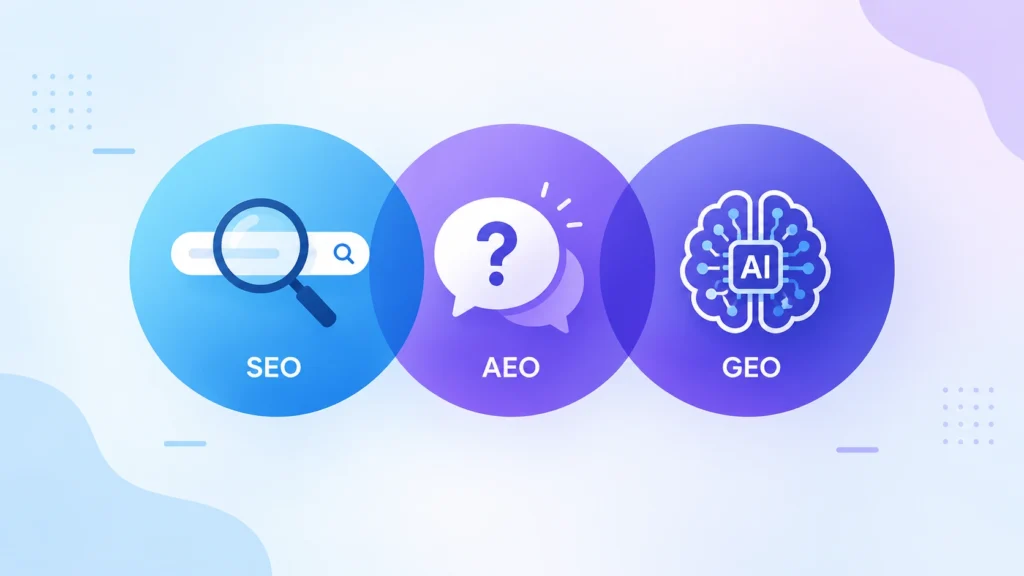
If you’ve been keeping up with digital marketing trends in 2025-2026, you’ve probably noticed a new set of acronyms floating around alongside the familiar SEO: AEO and GEO. With the rise of AI-powered search — think ChatGPT, Google’s AI Overviews, Perplexity, and voice assistants — the way people find information online is changing fast, and so is the way brands need to optimize for visibility.
Let’s break down what each of these terms means, how they differ, and why you probably need all three working together.
What is SEO (Search Engine Optimization)?
SEO is the practice of optimizing your website and content so it ranks higher on traditional search engine results pages (SERPs) like Google and Bing. It’s been the backbone of digital marketing for over two decades.
Core focus areas of SEO:
- Keyword research and on-page optimization
- Backlink building and domain authority
- Technical SEO (site speed, mobile-friendliness, crawlability)
- Content quality and relevance
- Local SEO (Google Business Profile, local citations)
Goal: Rank at the top of the “10 blue links” so users click through to your website.
What is AEO (Answer Engine Optimization)?
AEO focuses on optimizing content to appear as direct answers — think featured snippets, “People Also Ask” boxes, voice assistant responses (Siri, Alexa, Google Assistant), and knowledge panels. Instead of just ranking a page, AEO aims to get your content picked as the answer to a specific question.
Core focus areas of AEO:
- Structuring content in clear Q&A format
- Using schema markup (FAQ schema, HowTo schema)
- Writing concise, direct answers early in the content
- Targeting question-based, conversational queries
- Optimizing for voice search patterns
Goal: Become the direct answer a search engine or assistant reads back to the user — often without them ever clicking to your site.
What is GEO (Generative Engine Optimization)?
GEO is the newest of the three, and it’s built specifically for the AI chatbot era — optimizing your content so it gets cited, referenced, or summarized by generative AI tools like ChatGPT, Claude, Gemini, Perplexity, and Google’s AI Overviews.
Core focus areas of GEO:
- Being cited as a trustworthy source within AI-generated answers
- Structuring content so LLMs can easily extract and summarize it
- Building topical authority and brand mentions across the web (not just backlinks)
- Providing statistics, expert quotes, and clear factual claims AI models like to cite
- Ensuring content is crawlable by AI bots (and not blocked in robots.txt)
Goal: Get mentioned or cited by name when someone asks an AI chatbot a question related to your niche — even if there’s no click involved at all.
SEO vs AEO vs GEO: Side-by-Side Comparison
| Aspect | SEO | AEO | GEO |
|---|---|---|---|
| Platform | Google, Bing (SERPs) | Featured snippets, voice assistants | AI chatbots, AI Overviews |
| Goal | Rank high on results page | Become the direct answer | Get cited/mentioned by AI |
| User Action | Click to website | Often no click | Often no click |
| Content Style | Keyword-optimized, comprehensive | Concise, Q&A structured | Fact-rich, quotable, well-structured |
| Key Tactic | Backlinks, technical SEO | Schema markup, FAQ format | Brand mentions, authoritative data |
| Measurement | Rankings, organic traffic | Snippet ownership, voice results | AI citation frequency, brand mentions |
Why You Need All Three (Not Just One)
These three approaches aren’t competing strategies — they overlap and reinforce each other:
- Good SEO fundamentals (site structure, authority, quality content) form the foundation all three rely on.
- AEO tactics (clear structure, direct answers, schema) make your content easier for both search engines and AI models to parse.
- GEO builds on both by focusing on how your brand shows up in AI-generated conversations, which increasingly influence buying decisions before a user ever visits a website.
As AI Overviews and chatbot search grow, ignoring AEO and GEO means losing visibility in a rapidly expanding share of searches — even if your traditional rankings stay strong.
Quick Takeaways
- SEO = ranking on search engine results pages
- AEO = becoming the direct answer to a question
- GEO = getting cited by AI chatbots and generative search tools
The smartest content strategy in 2026 treats these as layers of the same goal: being the most trustworthy, clearly structured, and authoritative source — no matter where someone finds their answer.