Digital Marketing

Digital Marketing

Why Hire a Freelance Digital Marketer in India in 2026?

Why Hire a Freelance Digital Marketer in India in 2026? The digital marketing landscape has shifted dramatically, and businesses — from scrappy startups to established enterprises — are increasingly choosing freelance digital marketers over traditional agencies or in-house teams. Nowhere is this trend more visible than in India, which has become a global hub for skilled, affordable, and results-driven marketing talent. Here’s why 2026 might be the year you make the switch. 1. Cost-Effective Without Compromising Quality Hiring a full-time in-house marketer means salary, benefits, training, and office overhead. Agencies come with retainer fees that often include costs for account managers you’ll never directly work with. Freelance digital marketers in India offer a middle ground: you pay for actual expertise and output, often at a fraction of Western market rates, without sacrificing quality. India’s marketers are known for delivering agency-level work at freelancer-level pricing. 2. Access to a Deep, Diverse Talent Pool India produces one of the largest pools of digital marketing professionals in the world, spanning SEO, paid ads, content marketing, social media, email marketing, and marketing automation. Many have hands-on experience across industries — SaaS, e-commerce, D2C, fintech, healthcare — giving you access to specialized skill sets tailored to your niche. 3. English Proficiency and Global Market Understanding Unlike some outsourcing destinations, India has widespread English fluency, making communication, content creation, and campaign strategy seamless. Indian freelancers also have strong exposure to Western consumer behavior, platforms (Google, Meta, LinkedIn), and marketing trends, since much of their client base historically comes from the US, UK, Australia, and the Middle East. 4. Flexibility and Scalability Freelancers offer project-based or hourly engagements, letting you scale marketing efforts up or down based on business needs — without long-term commitments. Running a seasonal campaign? Testing a new channel? Need extra support during a product launch? You can bring in specialized freelance talent exactly when you need it. 5. Time Zone Advantage India’s time zone allows for near round-the-clock workflows when paired with teams in the US, UK, or Europe. Work handed off at the end of your day can often be completed and ready for review by the time you’re back online — effectively extending your working hours. 6. Up-to-Date with 2026 Digital Marketing Trends Freelancers, especially those serving international clients, tend to stay sharp on the latest trends to remain competitive. In 2026, expect Indian digital marketers to be well-versed in: AI-powered marketing tools and automation First-party data strategies (post-cookie era) Short-form video and platform-native content (Reels, Shorts) Conversational and voice search optimization Performance marketing powered by predictive analytics 7. Personalized Attention Unlike agencies juggling dozens of clients, a freelancer typically manages a smaller roster, meaning you often get more direct communication, faster turnaround, and a marketer who genuinely understands your brand and goals — not just executes a templated playbook. 8. Easy to Test Before Committing Long-Term Freelance engagements are low-risk. You can start with a single project — a website audit, one ad campaign, a content calendar — to evaluate fit before scaling the relationship into something long-term. How to Find the Right Freelance Digital Marketer in India Check portfolios and case studies, not just testimonials Ask for references from past international clients Start with a small paid project before a bigger commitment Clarify reporting cadence and communication tools upfront (Slack, email, weekly calls) Use platforms like Upwork, LinkedIn, Fiverr Pro, or niche marketing communities to vet talent   Final Thoughts In 2026, hiring a freelance digital marketer in India isn’t just a budget-friendly decision — it’s a strategic one. With access to skilled, adaptable, and globally-aware talent, businesses of every size can build effective marketing engines without the overhead of traditional hiring models. Whether you need a specialist for a single campaign or an ongoing marketing partner, India’s freelance talent pool is well worth exploring

Digital Marketing

How to Choose the Right Digital Marketing Expert in Kerala

How to Choose the Right Digital Marketing Expert in Kerala Kerala’s business landscape is changing fast. From family-run spice exporters in Kochi to tech startups in Technopark and homestays across Munnar and Wayanad, more businesses are realizing that a strong online presence isn’t optional anymore — it’s the difference between being found and being forgotten. But here’s the catch: not every “digital marketing expert” is the right fit for your business. With so many freelancers, agencies, and self-proclaimed gurus offering services across cities like Kochi, Thiruvananthapuram, Kozhikode, and Thrissur, choosing the right one can feel overwhelming. This guide breaks down exactly what to look for, so you can make a confident, informed decision. Define What You Actually Need First Before you even start searching, get clear on your goals. “Digital marketing” is a broad umbrella that includes: SEO (search engine optimization) Social media marketing (Instagram, Facebook, LinkedIn) Paid advertising (Google Ads, Meta Ads) Content marketing (blogs, video, copywriting) Email marketing Web design and development A local restaurant chain in Ernakulam might need strong local SEO and Instagram marketing, while a B2B software company in Kochi might prioritize LinkedIn outreach and paid search campaigns. Knowing your priority helps you filter out experts who aren’t a match. Look for Proven Local Experience Kerala has its own consumer behavior, festival calendars (Onam, Vishu, Christmas), regional language preferences (Malayalam content often outperforms English for local audiences), and business culture. An expert who has worked with Kerala-based businesses — whether it’s a jewellery brand in Thrissur or an ayurveda center in Kottayam — will understand these nuances far better than someone applying a generic, one-size-fits-all strategy. What to ask: Can you share case studies or results from Kerala-based clients? Do you understand seasonal buying patterns here (Onam sales spikes, monsoon tourism dips, etc.)? Have you run campaigns targeting both English and Malayalam-speaking audiences? Check Their Own Digital Footprint This one’s simple but often overlooked: a digital marketing expert should be able to market themselves. Look at their website, social media profiles, Google reviews, and how they rank in search results for relevant keywords. If someone claims to be an SEO expert but their own website doesn’t show up on Google, that’s a red flag. Ask for Real Results, Not Just Promises Vague claims like “we’ll boost your traffic” or “guaranteed #1 ranking on Google” should raise concern — no ethical expert can guarantee search rankings, since algorithms change constantly. Instead, ask for: Specific metrics from past campaigns (traffic growth, conversion rates, ROAS on ads) Client testimonials or references you can actually contact A sample strategy or audit of your current online presence Understand Their Pricing and Transparency Digital marketing pricing in Kerala varies widely — from freelancers charging a few thousand rupees a month to full-service agencies with retainer packages running into lakhs. Neither extreme is automatically better. What matters is transparency: Is there a clear breakdown of what’s included (ad spend vs. service fee, content creation vs. reporting)? Do they explain how they’ll measure and report success? Are there hidden costs for tools, revisions, or extra platforms? Evaluate Communication and Reporting You don’t need to become a marketing expert yourself, but you should understand what’s being done and why. A good expert will: Set clear, realistic expectations from the start Provide regular reports in plain language, not just jargon-filled dashboards Be responsive and available for questions If someone is hard to reach before you’ve even signed on, that’s usually a preview of what working together will be like. Prioritize Strategy Over Tools Anyone can run a Facebook ad or post on Instagram. What separates a true expert is strategic thinking — understanding your target audience, positioning your brand against competitors, and adapting when something isn’t working. Ask potential experts how they’d approach your specific business challenge, not just what tools or platforms they use. Consider Agency vs. Freelancer vs. In-House Consider Agency vs. Freelancer vs. In-House Each option has trade-offs: Option Pros Cons Freelancer Often more affordable, flexible, personal attention May lack bandwidth for large or multi-channel campaigns Agency Full team of specialists (SEO, ads, design, content) Higher cost, sometimes less personalized In-house hire Deep familiarity with your brand, full-time focus Higher long-term cost, limited skill breadth For small businesses just starting out, a skilled freelancer or boutique agency in Kerala can offer a great balance of cost and quality. Larger businesses with bigger budgets often benefit from a full-service agency. Trust Your Gut During Initial Conversations Pay attention to how the person or team engages with you in the first few conversations. Do they ask thoughtful questions about your business, or do they jump straight into a sales pitch? Do they take time to understand your goals, or push a pre-packaged plan regardless of your needs? The right expert should feel like a partner invested in your success, not just a vendor closing a deal.   Final Thoughts Choosing the right digital marketing expert in Kerala comes down to a mix of local know-how, proven results, transparent communication, and genuine strategic thinking. Take your time, ask the right questions, and don’t be afraid to compare a few options before committing. The right partnership can genuinely transform how your business grows online — the wrong one just wastes your budget.

Digital Marketing

How GPT-6 Astra Could Change the Way Freelance Digital Marketers Work in Kerala

How GPT-6 Astra Could Change the Way Freelance Digital Marketers Work in Kerala Every time a major AI model launches, freelancers ask the same question: does this replace me, or does it make me faster? With OpenAI’s release of GPT-6 Astra this month, that question is worth asking again — especially for the growing community of freelance digital marketers working across Kerala, from Kochi’s startup scene to Thiruvananthapuram’s IT corridor. Astra isn’t just another chatbot update. It’s built around “computer use” — meaning it can operate software, browse the web, and complete multi-step tasks inside the actual tools marketers already use, not just generate text in a chat window. For a freelancer juggling five client accounts, that shift matters. What’s Actually New in GPT-6 Astra A few capabilities stand out for marketing work specifically: Stronger computer use. Astra can navigate real applications — ad dashboards, spreadsheets, CMS platforms — the way a person would, rather than requiring an API integration for every tool. Better task follow-through. OpenAI has emphasized improvements in understanding intent and sticking to task boundaries, so longer campaign workflows need less babysitting. Built-in site and app creation. Through “Sites” in ChatGPT, Astra can build and host simple websites or landing pages directly from a prompt — useful for quick client mockups or campaign microsites. Faster financial and data modeling. Early benchmarks show Astra completing spreadsheet-heavy work significantly faster than before, which carries over to campaign reporting and budget tracking.   What This Means for Freelance Digital Marketers in Kerala 1. Faster turnaround on repetitive work. Content calendars, ad copy variations, basic keyword research, and reporting dashboards are exactly the kind of repeatable tasks Astra is designed to speed up. Freelancers who bill by project rather than by hour stand to benefit most, since less time on routine work means better margins. 2. Lower barrier to offering “full-stack” services. A solo freelancer in Kerala competing against agencies has always been limited by hours in the day. If Astra can handle first-draft landing pages, basic automation, and campaign reporting, a single freelancer can credibly offer a wider range of services — SEO, paid ads, content, and light web work — without hiring a team. 3. Local and regional content still needs a human touch. Kerala businesses often need marketing that understands local festivals, Malayalam-English code-switching in ad copy, regional shopping behavior, and community trust dynamics. Astra can draft and structure content quickly, but the judgment calls — tone, cultural nuance, what resonates with a Kochi audience versus a Kozhikode one — remain a freelancer’s edge. 4. Client expectations will shift faster than the tools do. As more clients hear about AI models like Astra, some will expect faster turnarounds or lower rates. Freelancers who get ahead of this by openly incorporating AI tools into their workflow — and pricing based on outcomes rather than hours — will be in a stronger position than those who wait to be asked. Where Freelancers Should Be Cautious Astra is rolling out gradually, starting with a limited group before wider availability to paid ChatGPT tiers, so access and pricing may vary for now. It’s also a new model — freelancers should test it on lower-stakes tasks before relying on it for client deliverables, and always review AI-drafted content before it goes out under a client’s name. Accuracy, brand voice, and factual claims still need a human check. The Practical Takeaway For freelance digital marketers in Kerala, GPT-6 Astra is less a threat and more a lever. The freelancers who treat it as a way to handle the repetitive 70% of the job faster — while doubling down on strategy, local insight, and client relationships — are the ones most likely to grow their practice over the next year. The ones who ignore it, or who rely on it blindly without review, both risk falling behind in different ways. If you’re a freelancer in Kerala figuring out how to fit tools like Astra into your workflow, the smartest first step isn’t a full overhaul — it’s picking one recurring task (reporting, first-draft ad copy, or content briefs) and testing whether AI genuinely saves you time without costing you quality.

Digital Marketing

Freelance Digital Marketing Strategist in Calicut: Why Local Businesses Are Making the Switch

Freelance Digital Marketing Strategist in Calicut: Why Local Businesses Are Making the Switch Calicut (Kozhikode) has quietly become one of Kerala’s most active business hubs — from textile and jewellery showrooms in the heart of the city to homegrown D2C brands, restaurants, real estate developers, and export businesses working out of the coastal belt. As competition grows, more of these businesses are turning to a freelance digital marketing strategist instead of a full agency retainer or an in-house hire. Here’s why — and what to look for if you’re hiring one. Why Freelance, and Why Now Digital marketing in Calicut used to mean a Facebook boost post here and a WhatsApp broadcast there. That’s changed. Customers now discover local businesses through Google search, Instagram Reels, and Google Maps reviews before they ever walk into a shop. Meeting that shift needs strategy, not just posting — but most small and mid-sized Calicut businesses don’t have the budget for a full marketing team. A freelance strategist fills that gap: Lower cost, senior thinking — you get strategic-level input without agency overheads or a full-time salary. Local market understanding — someone based in Calicut understands the city’s buying patterns, festive spending cycles (Onam, Ramzan, wedding season), and how word-of-mouth still drives decisions alongside digital channels. Flexibility — freelancers can scale up during a launch or campaign and scale down during quieter months. What a Freelance Digital Marketing Strategist Actually Does It’s more than “managing social media.” A strategist typically works across: Market and competitor research — understanding what’s working for similar businesses in Kozhikode, Kannur, and even Kochi. Local SEO — optimizing Google Business Profile listings so a business shows up when someone searches “near me” in Calicut. Content strategy — planning what to post, when, and why, rather than posting reactively. Paid advertising — running targeted Meta and Google Ads campaigns with a Kerala-specific audience and budget in mind. Analytics and reporting — tracking what’s actually bringing in enquiries and sales, not just likes. What to Look for When Hiring One in Calicut A portfolio with local or regional clients — someone who has worked with Kerala businesses will understand language nuance (Malayalam + English content), local platforms, and regional buying behaviour. Clear deliverables — a good freelancer will define what a month of work includes: number of posts, ad spend management, reporting frequency. Comfort with both English and Malayalam content — much of Calicut’s audience responds better to a mix of both, especially in captions and ad copy. Transparency on ad spend vs. service fee — this should always be separated clearly in any proposal.   Who Typically Hires One Boutique and jewellery showrooms wanting festive-season campaigns Restaurants and cloud kitchens needing consistent Instagram and delivery-app visibility Real estate and interior design firms needing lead-generation funnels Educational institutes and coaching centres around admission season Export and trading businesses building a B2B presence on LinkedIn   Final Thoughts For Calicut’s growing business scene, a freelance digital marketing strategist offers something agencies often can’t at the same price point: direct access, faster turnaround, and a strategist who genuinely understands the local market — not a template built for a metro city. If you’re a business owner in Calicut looking to grow online, or a marketer looking to freelance in this space, the opportunity right now is real — the market is moving faster than the supply of good local talent.

Best Digital Marketer in Calicut
Digital Marketing

Best Freelance Digital Marketer in Calicut: What to Look for Before Hiring

How AI Is Changing Digital Marketing in 2026Best Freelance Digital Marketer in Calicut: What to Look for Before Hiring Calicut (Kozhikode) has quietly become one of Kerala’s most active hubs for small businesses, D2C brands, real estate players, and local service providers looking to grow online. As demand rises, so does the number of people calling themselves “digital marketers” on LinkedIn and Instagram. Some are genuinely skilled. Many are not. If you’re a business owner in Calicut planning to hire a freelance digital marketer, this guide will help you separate the professionals from the pretenders — before you spend a single rupee. Why Businesses in Calicut Are Turning to Freelancers Hiring a full-time in-house marketer or signing up with a large agency isn’t always practical for small and mid-sized businesses. Freelancers offer: Lower cost compared to agency retainers Direct communication — no account managers or middlemen Flexibility — scale up or down based on your budget and season Local market understanding — someone who knows Kerala’s audience, language nuances, and festival/seasonal buying patterns But this flexibility only pays off if you hire the right person. What to Look for Before Hiring 1. A Portfolio With Real, Verifiable Results Don’t settle for a portfolio full of vague claims like “increased engagement.” Ask for specifics: Which businesses have they worked with in Calicut or Kerala? What was the measurable outcome — leads generated, sales growth, follower-to-conversion ratio? Can they show before-and-after data (Google Analytics, ad account screenshots, Meta Business Suite reports)? A genuine freelancer will happily walk you through real numbers instead of just showing pretty creatives. 2. Clarity on Which Services They Actually Specialize In “Digital marketing” is an umbrella term covering SEO, paid ads, social media management, content marketing, email marketing, and web analytics. Nobody is equally excellent at all of these. Ask directly: “What are you best at, and what do you outsource or avoid?” A marketer who claims mastery over everything is usually a generalist with shallow knowledge across the board. 3. Understanding of the Local Calicut/Kerala Market A freelancer working with businesses in Calicut should understand: Regional buying behavior and festival-driven demand (Onam, Eid, wedding season) Bilingual content strategy — knowing when Malayalam content outperforms English Local competitor landscape, especially if you’re in retail, real estate, education, or hospitality This local context often matters more than generic “growth hacking” tactics copied from global templates. 4. Transparent Pricing and Deliverables Before hiring, get absolute clarity on: What exactly is included in the monthly fee (number of posts, ad spend management, reporting frequency) Whether ad spend is separate from the service fee Turnaround time for content approvals and campaign changes Contract terms — month-to-month vs. long-term lock-in Freelancers who avoid giving you a clear scope of work are a red flag. 5. Reporting and Communication Habits Ask how they report progress. A reliable freelancer should offer: Weekly or bi-weekly check-ins Monthly performance reports with actual metrics (not just screenshots of likes) Willingness to explain why something worked or didn’t If a marketer disappears for weeks and only resurfaces to ask for the next payment, that’s a serious warning sign. 6. Tools They Actually Use Ask which tools are part of their regular workflow — Google Analytics, Meta Ads Manager, Google Ads, SEMrush/Ahrefs, Canva, or scheduling tools like Buffer/Later. Comfort with these tools signals they’re running a professional process, not guessing. 7. References and Reviews Request contact details of 1–2 past clients, ideally local businesses. A quick call asking “Would you hire them again?” reveals more than any portfolio slide ever will. Red Flags to Watch Out For Promises of “guaranteed #1 Google ranking” or “10,000 followers in a month” Reluctance to share past client names or results No clear pricing structure Overuse of jargon with no substance behind it Asking for full payment upfront before any work begins Questions to Ask During the First Call Can you share 2–3 case studies relevant to my industry? How do you measure success for a business like mine? What does a typical month of work look like? How do you handle underperforming campaigns? What’s your communication and reporting schedule? Final Thoughts The right freelance digital marketer in Calicut can genuinely transform a local business’s online presence — but the wrong one can waste months of budget and momentum. Take your time during the hiring process, ask pointed questions, and prioritize transparency and proven results over flashy promises. A good freelancer won’t just execute tasks — they’ll act as a strategic partner who understands both digital marketing fundamentals and the unique pulse of the Calicut market.

Digital Marketing

How AI Is Changing Digital Marketing in 2026

How AI Is Changing Digital Marketing in 2026 Remember when “AI in marketing” basically meant a chatbot that misunderstood your question three times before connecting you to a human? Yeah, that phase is pretty much over. Walk into any marketing team’s stand-up today and AI isn’t the shiny new tool someone’s testing on the side — it’s just… there. Running through the ad spend, drafting the first pass of the email, flagging which customers are about to churn before anyone noticed a pattern. So what’s actually changed, beyond the hype? Here’s what I’m seeing. Key Shifts Driving This Change 1. Search Is No Longer Just Search Here’s the thing nobody saw coming quite this fast: people stopped typing keywords and started just… asking. Instead of googling “best running shoes flat feet,” someone now types (or says) “what running shoes should I get, I’ve got flat feet and not much of a budget” into an AI assistant — and gets back an actual answer, with picks, not ten blue links. That’s rattled a lot of SEO playbooks. It’s not enough to rank #1 on Google anymore (though sure, that still helps). Now brands are chasing something a bit blurrier: getting cited by the AI itself. That means writing content that’s actually clear and well-sourced, tagging things properly with schema, and — honestly — just being credible enough that a model trusts you as a source. People are calling this GEO (generative engine optimization), though I suspect the name will change five more times before it sticks. 2. Hyper-Personalization at a Scale Humans Can’t Match “Hi [First Name]” used to count as personalization. Wild to think about now. What’s happening in 2026 is a lot more granular — systems are watching how someone scrolls, where they hesitate, what time of day they’re browsing, and adjusting the message in real time, not the next campaign cycle. A few places this shows up: Email and ad copy that’s rewritten per person, not per segment Websites that quietly reorder themselves based on what you seem to want A product recommendation at 11pm that reads differently than the one you’d get at lunch The upshot? Campaigns that used to ship with five variants now effectively have unlimited ones, constantly testing themselves against each other. 3. Creative Production Has Compressed Ad copy, image concepts, a rough video cut — stuff that used to eat up a creative team’s whole week now gets a first draft in an afternoon. AI’s doing a lot of the grunt work: drafting, generating, editing, even voiceover. But here’s what’s interesting — this hasn’t made creative teams less important, it’s just changed what they’re actually doing. Less “produce the thing,” more “decide if the thing is any good and sounds like us.” The teams pulling ahead aren’t the ones cranking out the most content. They’re the ones running more experiments, killing the bad ideas faster, and keeping enough of a real voice that none of it feels like it came out of a machine (even when it did). 4. Predictive Analytics Moved From “Nice to Have” to Default Not long ago, predicting who was about to churn or which leads were worth chasing meant you needed an actual data science team on staff. Now it’s just baked into most marketing platforms out of the box. You can see, before a campaign even goes live, which segments are likely to bite and which creative is probably going to flop. Budgets have shifted because of it — less “spend and hope,” more “spend where the model says it’ll land, and adjust as you go.” 5. AI Agents Are Running Campaigns, Not Just Assisting Them This one’s the big shift, honestly. AI isn’t just suggesting anymore — it’s doing. Autonomous agents are adjusting bids, pausing an underperforming ad, moving budget between channels, kicking off follow-up sequences, all without someone clicking “approve” first. Marketers are spending more time setting the strategy and the guardrails, less time babysitting the day-to-day. It’s a shift from operator to supervisor — which is great for efficiency, but it does raise a real question: how much do you let it run on its own before someone should be looking over its shoulder? 6. Trust, Authenticity, and the Backlash Factor Funny thing about a world flooded with AI content: people got more skeptical, not less. There’s a real premium now on stuff that feels unmistakably human — actual customer stories, rough behind-the-scenes footage, brands being upfront about where AI was involved. Some are leaning into “human-made” as an actual selling point. And regulators are catching up too — more places now require disclosure when AI’s involved in ads, especially with synthetic media or influencer content. What This Means for Marketers in 2026 SEO folks need to stop thinking only about Google and start thinking about how AI assistants summarize and surface things Creative teams are shifting from “make more” to “make it good and make it ours” Analytics is getting more strategic — less number-crunching, more deciding how much autonomy the models get Trust and transparency aren’t just nice values anymore, they’re a genuine edge POV At the end of the day, AI hasn’t replaced marketing strategy — it’s just raised the floor on execution and made “good enough” a lot harder to get away with. The brands doing well in 2026 aren’t necessarily the ones with the fanciest AI stack. They’re the ones who figured out how to pair that speed and scale with something AI still can’t fake: an actual point of view.

Digital Marketing

SEO vs AEO vs GEO: What’s the Difference?

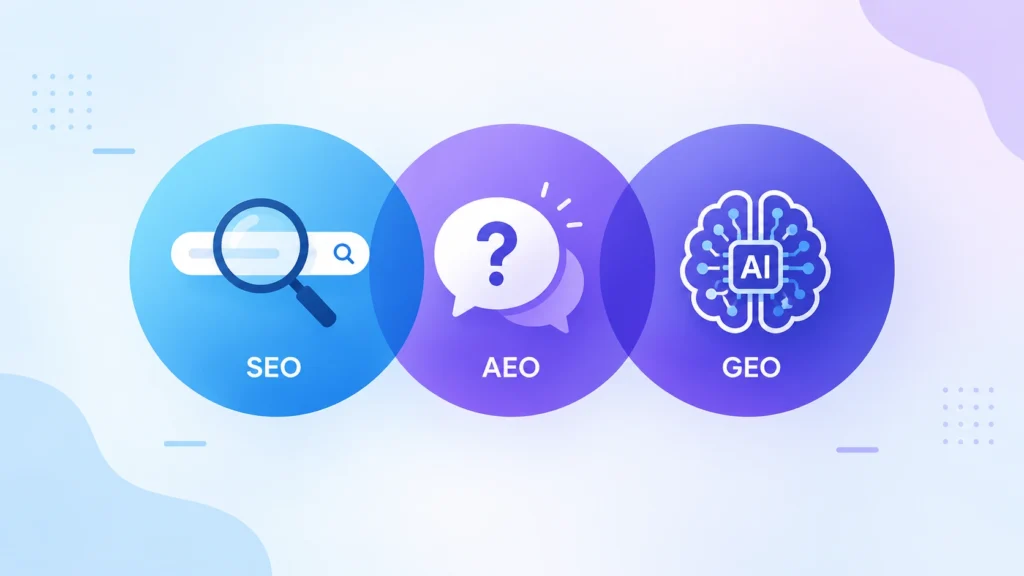
SEO vs AEO vs GEO: What’s the Difference? If you’ve been keeping up with digital marketing trends in 2025-2026, you’ve probably noticed a new set of acronyms floating around alongside the familiar SEO: AEO and GEO. With the rise of AI-powered search — think ChatGPT, Google’s AI Overviews, Perplexity, and voice assistants — the way people find information online is changing fast, and so is the way brands need to optimize for visibility. Let’s break down what each of these terms means, how they differ, and why you probably need all three working together. What is SEO (Search Engine Optimization)? SEO is the practice of optimizing your website and content so it ranks higher on traditional search engine results pages (SERPs) like Google and Bing. It’s been the backbone of digital marketing for over two decades. Core focus areas of SEO: Keyword research and on-page optimization Backlink building and domain authority Technical SEO (site speed, mobile-friendliness, crawlability) Content quality and relevance Local SEO (Google Business Profile, local citations) Goal: Rank at the top of the “10 blue links” so users click through to your website. What is AEO (Answer Engine Optimization)? AEO focuses on optimizing content to appear as direct answers — think featured snippets, “People Also Ask” boxes, voice assistant responses (Siri, Alexa, Google Assistant), and knowledge panels. Instead of just ranking a page, AEO aims to get your content picked as the answer to a specific question. Core focus areas of AEO: Structuring content in clear Q&A format Using schema markup (FAQ schema, HowTo schema) Writing concise, direct answers early in the content Targeting question-based, conversational queries Optimizing for voice search patterns Goal: Become the direct answer a search engine or assistant reads back to the user — often without them ever clicking to your site. What is GEO (Generative Engine Optimization)? GEO is the newest of the three, and it’s built specifically for the AI chatbot era — optimizing your content so it gets cited, referenced, or summarized by generative AI tools like ChatGPT, Claude, Gemini, Perplexity, and Google’s AI Overviews. Core focus areas of GEO: Being cited as a trustworthy source within AI-generated answers Structuring content so LLMs can easily extract and summarize it Building topical authority and brand mentions across the web (not just backlinks) Providing statistics, expert quotes, and clear factual claims AI models like to cite Ensuring content is crawlable by AI bots (and not blocked in robots.txt) Goal: Get mentioned or cited by name when someone asks an AI chatbot a question related to your niche — even if there’s no click involved at all. SEO vs AEO vs GEO: Side-by-Side Comparison Aspect SEO AEO GEO Platform Google, Bing (SERPs) Featured snippets, voice assistants AI chatbots, AI Overviews Goal Rank high on results page Become the direct answer Get cited/mentioned by AI User Action Click to website Often no click Often no click Content Style Keyword-optimized, comprehensive Concise, Q&A structured Fact-rich, quotable, well-structured Key Tactic Backlinks, technical SEO Schema markup, FAQ format Brand mentions, authoritative data Measurement Rankings, organic traffic Snippet ownership, voice results AI citation frequency, brand mentions Why You Need All Three (Not Just One) These three approaches aren’t competing strategies — they overlap and reinforce each other: Good SEO fundamentals (site structure, authority, quality content) form the foundation all three rely on. AEO tactics (clear structure, direct answers, schema) make your content easier for both search engines and AI models to parse. GEO builds on both by focusing on how your brand shows up in AI-generated conversations, which increasingly influence buying decisions before a user ever visits a website. As AI Overviews and chatbot search grow, ignoring AEO and GEO means losing visibility in a rapidly expanding share of searches — even if your traditional rankings stay strong. Quick Takeaways SEO = ranking on search engine results pages AEO = becoming the direct answer to a question GEO = getting cited by AI chatbots and generative search tools The smartest content strategy in 2026 treats these as layers of the same goal: being the most trustworthy, clearly structured, and authoritative source — no matter where someone finds their answer.

Digital Marketing

What Is Digital Marketing? A Complete Guide for Beginners

What Is Digital Marketing? A Complete Guide for Beginners Digital marketing is one of those terms everyone uses but few people explain clearly. If you’re a beginner — whether you’re a business owner, a student, or someone thinking about a career in marketing — this guide will walk you through everything you need to know, from the basics to how it all fits together. What is Digital Marketing? Digital marketing is the practice of promoting products, services, or a brand using digital channels — the internet, mobile apps, search engines, social media, and more — instead of traditional media like TV, print, or radio. In simple terms: if you’re marketing to people through a screen, that’s digital marketing. Why Digital Marketing Matters Today People spend hours daily on their phones — scrolling social media, searching Google, watching videos. It’s measurable — you can see exactly how many people saw your ad, clicked it, or bought because of it. It’s cost-effective — you can start with a small budget, unlike traditional advertising. It allows precise targeting — reaching the exact audience (age, location, interest) most likely to buy. The Core Types of Digital Marketing 1. Search Engine Optimization (SEO) The process of improving your website so it ranks higher on Google for relevant searches. SEO brings free, long-term traffic but takes time to show results. 2. Search Engine Marketing (SEM) / Paid Ads Paying to appear at the top of search results or on other platforms (Google Ads, Facebook Ads). Faster results than SEO, but costs stop when your budget does. 3. Social Media Marketing Using platforms like Instagram, Facebook, LinkedIn, and YouTube to build brand awareness, engage audiences, and drive traffic or sales. 4. Content Marketing Creating valuable content — blogs, videos, guides, infographics — to attract and educate your audience, building trust over time. 5. Email Marketing Sending targeted emails to nurture leads, share offers, or keep customers engaged. Still one of the highest ROI channels when done right. 6. Affiliate Marketing Partnering with individuals or other businesses who promote your product for a commission on sales they generate. 7. Influencer Marketing Collaborating with social media influencers to reach their audience and build credibility through association. 8. Local SEO / Google My Business Optimizing your online presence to attract customers searching for businesses near them. How Digital Marketing Works Together These channels aren’t meant to be used in isolation. A typical customer journey might look like: Someone sees your Instagram post (Social Media) They search your brand name on Google and land on your blog (SEO/Content) They sign up for your newsletter (Email Marketing) A retargeting ad reminds them to complete a purchase (Paid Ads) This is why most effective digital marketing strategies combine multiple channels rather than relying on just one. Key Terms Every Beginner Should Know Impressions – Number of times your content was shown Click-Through Rate (CTR) – Percentage of people who clicked after seeing your content Conversion Rate – Percentage of people who took the desired action (purchase, signup, etc.) CPC (Cost Per Click) – What you pay each time someone clicks your ad ROI (Return on Investment) – The profit generated compared to what you spent How to Start Learning Digital Marketing Pick one channel first — Don’t try to learn everything at once. Start with SEO or social media, whichever interests you more. Learn by doing — Start a blog, an Instagram page, or run a small ad campaign to apply what you learn. Use free resources — Google’s own courses (Google Digital Garage), YouTube tutorials, and official platform guides (Meta Blueprint, Google Skillshop) are great starting points. Track real campaigns — Even small, real-world practice teaches more than theory alone. Common Beginner Mistakes to Avoid Trying to master every channel at once instead of focusing Ignoring data and analytics — decisions should be based on numbers, not guesses Expecting instant results, especially with SEO and content marketing Focusing only on vanity metrics (likes, followers) instead of real business outcomes (leads, sales) Final Thoughts Digital marketing might seem overwhelming with all its channels and jargon, but at its core, it’s simple: reaching the right people, in the right place, with the right message — and measuring what works. Start with one channel, learn the fundamentals, and build from there. Every expert started exactly where you are now.

Digital Marketing

What is Digital Marketing? A Simple Guide for Kerala Business Owners

What is Digital Marketing? A Simple Guide for Kerala Business Owners If you own a shop, restaurant, clinic, or any small business in Kerala, you’ve probably heard the term “digital marketing” thrown around a lot. Maybe someone told you “you need to do digital marketing to grow,” but nobody actually explained what that means. This guide breaks it down in plain language — no jargon, just what you need to know. What is Digital Marketing, Really? Digital marketing simply means promoting your business using the internet instead of (or along with) traditional methods like newspaper ads, flyers, or banners. Instead of hoping someone walks past your shop, digital marketing helps you reach people: While they’re scrolling Instagram or Facebook While they’re searching “near me” on Google While they’re watching YouTube While they’re checking WhatsApp In short — it’s about being visible where your customers already are, which today is mostly online.   The Main Types of Digital Marketing (Explained Simply) You don’t need to master all of these. But it helps to know what they mean: 1. SEO (Search Engine Optimization) Making sure your business shows up when someone searches on Google — like “best bakery in Kochi” or “digital marketer in Kerala.” 2. Social Media Marketing Using platforms like Instagram, Facebook, and YouTube to showcase your products, build trust, and stay in front of your audience regularly. 3. Paid Advertising (Ads) Running paid campaigns on Google, Facebook, or Instagram to reach a specific audience quickly — useful when you want faster results than SEO. 4. Google My Business / Local SEO Setting up your business on Google Maps so people searching “near me” can find your location, contact number, and reviews. 5. WhatsApp Marketing Very relevant in Kerala — many businesses now use WhatsApp broadcasts and catalogs to share offers and take orders directly. 6. Content Marketing (like this blog!) Creating helpful content — blogs, videos, posts — that answers your customers’ questions and builds trust before they even contact you.   Why Does This Matter for a Kerala Business? People in Kerala are highly active on smartphones — checking Instagram, searching Google, sharing on WhatsApp. Whether you’re in Kochi, Kozhikode, Thrissur, or a smaller town, your potential customers are already online. If your business isn’t visible there, you’re likely losing customers to a competitor who is — even if your product or service is better. Do You Need to Do All of This? No. This is a common misconception. You don’t need to be on every platform doing everything at once. The right starting point depends on your business: Local shop or service? Start with Google My Business + local SEO. Visual product (food, fashion, décor)? Instagram and Facebook will work well. Need quick results for an offer/event? Paid ads make sense. High-value service (like clinics, real estate)? A mix of Google presence + trust-building content works best. A good digital marketer will help you figure out where to focus first, instead of trying to do everything and spreading your budget thin. Common Myths About Digital Marketing? “It’s only for big companies” — False. Small businesses in Kerala benefit the most because it’s cheaper than traditional advertising and more targeted. “I just need more followers” — Followers don’t pay bills. Focus on leads, calls, and sales instead. “Results happen overnight” — Some things (like ads) can bring quick results, but SEO and content take consistent effort over weeks/months.   Final Thoughts Digital marketing isn’t complicated once you understand the basics — it’s simply about meeting your customers where they already spend their time: online. If you’re a Kerala business owner just starting out, you don’t need to learn everything yourself. Start with understanding these basics, figure out where your customers are most active, and build from there — or work with someone who can guide you through it.

Digital Marketing

How to Choose a Digital Marketer in Kerala (Questions to Ask Before Hiring)

How to Choose a Digital Marketer in Kerala (Questions to Ask Before Hiring) If you run a business in Kerala — whether it’s a shop in Kochi, a restaurant in Kozhikode, or a service business in Thrissur — chances are you’ve thought about hiring a digital marketer. But with so many freelancers and agencies claiming to “grow your business online,” how do you actually pick the right one? Here’s a practical guide to help you make the right call. 1. What results have they actually delivered? Don’t just ask “do you do SEO?” or “do you run ads?” — everyone will say yes. Ask instead: “Can you show me a business you’ve worked with in Kerala?” “What was the result — more calls, more orders, more footfall?” “Can I speak to one of your past clients?” A marketer who’s confident in their work will happily share real examples, not just screenshots of follower counts.   2. Do they understand your local market? Digital marketing for a Kerala audience is different from a generic national campaign. Language, festivals, local search behavior (like “near me” searches in Malayalam-English mix), and even the tone of ads matter. Ask them: “How would you target customers in my city specifically?” “Do you create content in Malayalam, English, or both — depending on what works?” 3. What exactly is included in their pricing? This is where a lot of business owners get confused later. Before hiring, get clarity on: Is ad spend separate from their service fee? How many posts, ads, or blogs are included per month? Is there a minimum contract period? What happens if you want to stop after one month? A transparent marketer will explain this clearly upfront — no vague “package” talk. 4. How do they measure success? Vanity metrics like likes and followers don’t pay your bills. Ask: “How will I know this is working?” “Will I get a monthly report? What will it show — leads, calls, sales, or just reach?” Good marketers track things that actually matter to your business, not just social media numbers. 5. Freelancer or agency — which fits you better? Both have their place: Freelancers (like a solo digital marketer) often give more personal attention, faster replies, and lower cost — great for small and local businesses. Agencies may offer more manpower and services, but can be more expensive and less personal, especially for a small budget. If you’re a small business in Kerala just starting with digital marketing, a dedicated freelancer often makes more sense — you get direct communication with the person actually doing the work. 6. How well do they communicate? This matters more than people think. Ask yourself after your first conversation: Did they explain things in a way I understood, without confusing jargon? Did they listen to my business needs, or just pitch a standard package? Do they reply quickly, or do I have to chase them? If communication feels difficult before you’ve even hired them, it usually gets worse afterward. 7. Do they set realistic expectations? Be cautious of anyone who promises: “Guaranteed #1 ranking on Google” “10,000 followers in a week” “Viral results overnight” Real digital marketing takes consistent effort over weeks and months. Someone honest about timelines is more trustworthy than someone overselling instant results. Quick Checklist Before You Hire Ask for real Kerala-based client examples Understand exactly what’s included in the price Clarify how results will be reported Compare freelancer vs agency fit for your budget Notice how clearly they communicate Be wary of unrealistic promises Final Thoughts Choosing the right digital marketer isn’t about picking the cheapest option or the one with the fanciest website — it’s about finding someone who understands your business, communicates clearly, and can show real results for businesses like yours in Kerala. Take your time, ask the right questions, and don’t be afraid to have a proper conversation before signing up.

Scroll to Top